 |
 |
| Make a slideshow design |
Tuesday, March 25, 2014
Intro to 3-D Geometry
This is a short slide show I created about 3-D Geometry!

Monday, February 3, 2014
Tree Diagrams Are Helpful!
Figuring out probabilities can be hard. Sometimes you add, sometimes you multiply, and it can get confusing. Tree Diagrams are here to help!
Here is a tree diagram for the toss of a coin:
We can extend the tree diagram to tossing a coin twice:

How do we calculate the overall probabilities?
 So there you go, when in doubt draw a tree diagram, multiply along the
branches and add the columns. Make sure all probabilities add to 1 and
you are good to go.
So there you go, when in doubt draw a tree diagram, multiply along the
branches and add the columns. Make sure all probabilities add to 1 and
you are good to go.
If you are still a little confused, visit mathisfun.com to see another helpful example.
Here is a tree diagram for the toss of a coin:
 |
There are two "branches" (Heads and Tails)
|
How do we calculate the overall probabilities?
- We multiply probabilities along the branches
- We add probabilities down columns
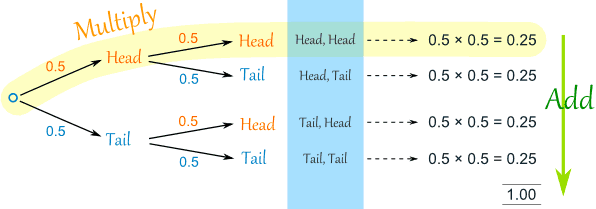 So there you go, when in doubt draw a tree diagram, multiply along the
branches and add the columns. Make sure all probabilities add to 1 and
you are good to go.
So there you go, when in doubt draw a tree diagram, multiply along the
branches and add the columns. Make sure all probabilities add to 1 and
you are good to go.If you are still a little confused, visit mathisfun.com to see another helpful example.
Wednesday, January 22, 2014
How Do We Determine Probability?
For my first real, math topic posting we will be learning about Probability! More precisely we will discuss how probabilities are determined. There are a few vocabulary words we need to go over before we get started. They are fairly simple.
1. Experiment - Results of an activity that can be observed and recorded.
2. Outcome - The possible results of an experiment.
3. Sample Space - A set of all possible outcomes for an experiment.
4. Event - Any subset of a sample space.
When discussing probability in a classroom it is important to use terminology that students associate with and will understand. For example Kindergarten-Second Grade will use likely and unlikely when referring to probability. Third-Fifth Grade will understand certain, equally likely, and impossible. Sixth-Eighth will begin making conjectures.

There is something call the Law of Large Numbers or Bernoulli's Theorem that goes along with theoretical probability. It states that if an experiment is repeated a large number of times, the experimental probability of an outcome approaches a fixed number, thus approaching an outcome of theoretical probability, as the number or repetitions increases.
If we look at Ms. Frewin from frewin.weebly.com, she helps generalize. In a special situation where all the outcomes in S are equally likely, we can find the probability of any event A by dividing the number of outcomes in A by the number of outcomes in S:

If you have S = (1,2,3,...25) and a number is chosen at random with the same chance of being drawn as all the other numbers in the set, this is what happens:
Event A - an even numbers are drawn - A=(2,4,6,8,10,12,14,16,18,20,22,24) n(A) = 12
n(S) = 25
Event B - a number less than 10 and greater than 20 is drawn B = Ø, so n(B) = 0
n(S) = 25
Event C - a number less than 26 is drawn C=S, so n(C) = 25 = 1
n (S) = 25
Event D - a prime number is drawn - D=(2,3,5,7,11,13,17,19,23) n(D) = 9
n(S) = 25
When an impossible event occurs it is an event with no outcomes, meaning it has a probability of zero (0).
When a certain event occurs it is an event that has a probability of one (1).
There are two ideas I want to leave you with. The first is called Probability Theorems. This means the probability of an event is equal to the sum of the probabilities of the disjoint outcomes making up the event. Then there are Mutually Exclusive Events which are events that have nothing in common.
"If there is a 50-50 chance that something can go wrong, then 9 times out of ten it will." - Paul Harvey
1. Experiment - Results of an activity that can be observed and recorded.
2. Outcome - The possible results of an experiment.
3. Sample Space - A set of all possible outcomes for an experiment.
4. Event - Any subset of a sample space.
When discussing probability in a classroom it is important to use terminology that students associate with and will understand. For example Kindergarten-Second Grade will use likely and unlikely when referring to probability. Third-Fifth Grade will understand certain, equally likely, and impossible. Sixth-Eighth will begin making conjectures.
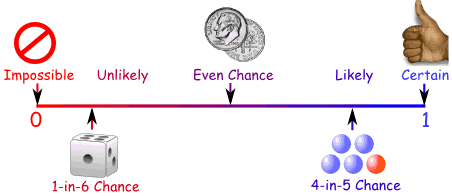
Probability is always between 0 and 1
When students first begin determining probabilities they need to know there are two types of probability. Experimental (empirical) Probability is determined by observing the outcomes of experiments performed by the students.Theoretical Probability is the outcome under ideal or perfect conditions. Students need to have a uniform sample space so that each outcome can be just as likely as another.There is something call the Law of Large Numbers or Bernoulli's Theorem that goes along with theoretical probability. It states that if an experiment is repeated a large number of times, the experimental probability of an outcome approaches a fixed number, thus approaching an outcome of theoretical probability, as the number or repetitions increases.
If we look at Ms. Frewin from frewin.weebly.com, she helps generalize. In a special situation where all the outcomes in S are equally likely, we can find the probability of any event A by dividing the number of outcomes in A by the number of outcomes in S:

Event A - an even numbers are drawn - A=(2,4,6,8,10,12,14,16,18,20,22,24) n(A) = 12
n(S) = 25
Event B - a number less than 10 and greater than 20 is drawn B = Ø, so n(B) = 0
n(S) = 25
Event C - a number less than 26 is drawn C=S, so n(C) = 25 = 1
n (S) = 25
Event D - a prime number is drawn - D=(2,3,5,7,11,13,17,19,23) n(D) = 9
n(S) = 25
When an impossible event occurs it is an event with no outcomes, meaning it has a probability of zero (0).
When a certain event occurs it is an event that has a probability of one (1).
There are two ideas I want to leave you with. The first is called Probability Theorems. This means the probability of an event is equal to the sum of the probabilities of the disjoint outcomes making up the event. Then there are Mutually Exclusive Events which are events that have nothing in common.
"If there is a 50-50 chance that something can go wrong, then 9 times out of ten it will." - Paul Harvey
Saturday, January 18, 2014
First Posting
This is my first post and I am very excited about starting this math blog for MAT157. Let me tell you a little bit about myself and then I can share more relevant math information with you. I am in my last semester at MCC and will be off to ASU in the fall to finish my Bachelor's Degree in Early Childhood Education. I have wanted to be a preschool teacher since I first started school. I currently work at the East Mesa KinderCare in the One's class. Even though it is not the age range I thought I be working with, I love my toddlers and I love my job.
For my first topic of discussion I wanted to share my personal favorite math website from when I was a kid; www.coolmath4kids.com. It was shared with me by my ALP teacher, the wonderful Mrs. Hausman, when I was in 5th grade. The game I played the most was Lemonade Stand. It lets you run your own lemonade stand by figuring out how much sugar and water, how many lemons and cups and other things one might need to run a lemonade stand. You must also figure out how to make a profit according to the changes in weather. The website has games and activities that include topics like addition and subtraction, multiplication and division, and decimals and fractions. It also includes a section for preschoolers. There is a sister website called www.coolmath.com. This site includes more advanced topics such as algebra, geometry and trig, and calculus. I really enjoyed this website as a kid because I struggled with math and this made it a lot more fun.
I look forward to sharing more about what I learn in class and I think this is going to be an exciting opportunity for me, my future students, and everyone I have the chance to share this blog with.
"Arithmetic is being able to count up to twenty without taking off your shoes." - Mickey Mouse
For my first topic of discussion I wanted to share my personal favorite math website from when I was a kid; www.coolmath4kids.com. It was shared with me by my ALP teacher, the wonderful Mrs. Hausman, when I was in 5th grade. The game I played the most was Lemonade Stand. It lets you run your own lemonade stand by figuring out how much sugar and water, how many lemons and cups and other things one might need to run a lemonade stand. You must also figure out how to make a profit according to the changes in weather. The website has games and activities that include topics like addition and subtraction, multiplication and division, and decimals and fractions. It also includes a section for preschoolers. There is a sister website called www.coolmath.com. This site includes more advanced topics such as algebra, geometry and trig, and calculus. I really enjoyed this website as a kid because I struggled with math and this made it a lot more fun.
I look forward to sharing more about what I learn in class and I think this is going to be an exciting opportunity for me, my future students, and everyone I have the chance to share this blog with.
"Arithmetic is being able to count up to twenty without taking off your shoes." - Mickey Mouse
Subscribe to:
Comments (Atom)