1. Experiment - Results of an activity that can be observed and recorded.
2. Outcome - The possible results of an experiment.
3. Sample Space - A set of all possible outcomes for an experiment.
4. Event - Any subset of a sample space.
When discussing probability in a classroom it is important to use terminology that students associate with and will understand. For example Kindergarten-Second Grade will use likely and unlikely when referring to probability. Third-Fifth Grade will understand certain, equally likely, and impossible. Sixth-Eighth will begin making conjectures.
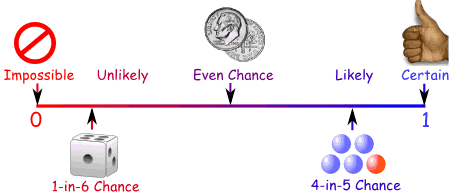
Probability is always between 0 and 1
When students first begin determining probabilities they need to know there are two types of probability. Experimental (empirical) Probability is determined by observing the outcomes of experiments performed by the students.Theoretical Probability is the outcome under ideal or perfect conditions. Students need to have a uniform sample space so that each outcome can be just as likely as another.There is something call the Law of Large Numbers or Bernoulli's Theorem that goes along with theoretical probability. It states that if an experiment is repeated a large number of times, the experimental probability of an outcome approaches a fixed number, thus approaching an outcome of theoretical probability, as the number or repetitions increases.
If we look at Ms. Frewin from frewin.weebly.com, she helps generalize. In a special situation where all the outcomes in S are equally likely, we can find the probability of any event A by dividing the number of outcomes in A by the number of outcomes in S:

Event A - an even numbers are drawn - A=(2,4,6,8,10,12,14,16,18,20,22,24) n(A) = 12
n(S) = 25
Event B - a number less than 10 and greater than 20 is drawn B = Ø, so n(B) = 0
n(S) = 25
Event C - a number less than 26 is drawn C=S, so n(C) = 25 = 1
n (S) = 25
Event D - a prime number is drawn - D=(2,3,5,7,11,13,17,19,23) n(D) = 9
n(S) = 25
When an impossible event occurs it is an event with no outcomes, meaning it has a probability of zero (0).
When a certain event occurs it is an event that has a probability of one (1).
There are two ideas I want to leave you with. The first is called Probability Theorems. This means the probability of an event is equal to the sum of the probabilities of the disjoint outcomes making up the event. Then there are Mutually Exclusive Events which are events that have nothing in common.
"If there is a 50-50 chance that something can go wrong, then 9 times out of ten it will." - Paul Harvey
